
Written by: Sarah Olaniyi
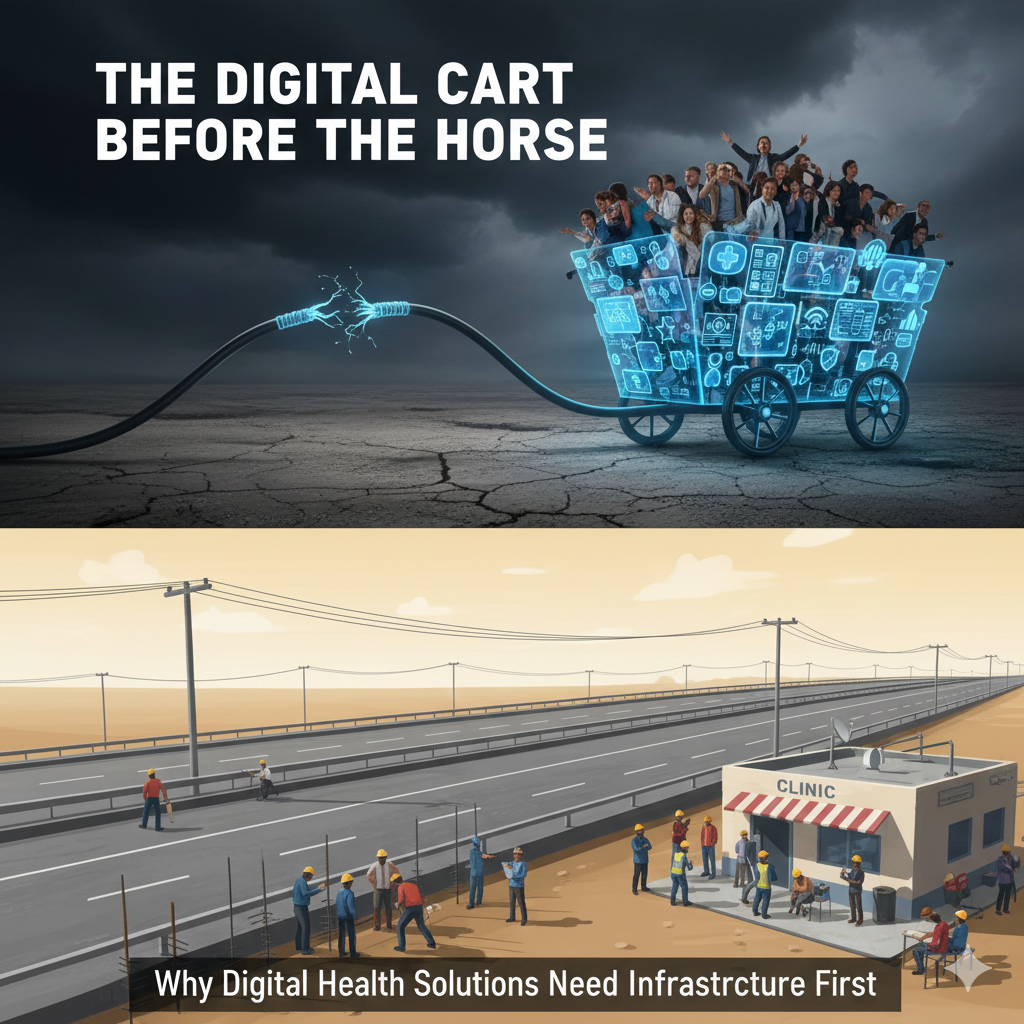
One of the most significant influences of the 21st century is the rapid acceleration and expansion of digital technologies, building on millennia of innovation, with healthcare having a share in its impact. Solutions have been provided to many health problems, healthcare systems have been revamped and restructured, and the quality of life of people has improved significantly with the advent of digital health solutions like electronic health records (EHRs), telemedicine, remote patient monitoring, diagnostics, and personalized medicine through artificial intelligence. Technological programs are thriving and rapidly growing, particularly among the nations of the Global North.
In line with the massive trajectory towards creating more digital technologies, some policies have been drafted to guide the implementation of digital health globally and in countries around the world. For example, the World Health Organisation (WHO) drafted a policy on “WHO Global Strategy on Digital Health (2020-2025)” with the vision to ensure that digital health is not treated as a luxury but as a vital component of Universal Health Coverage. It aims to reduce the digital divide observed globally, improve digital literacy, and ensure that those who cannot afford to use digital tools are also catered for. The WHO also drafted a policy on the “Ethics and governance of artificial intelligence for health: Guidance on large multi-modal models” in January 2024. Nigeria, in response to the call to action, developed the “Nigeria Digital Health Strategy 2021–2025,” which aims to create a unified Electronic Health Record (EHR) platform across all Federal Tertiary Hospitals. The Nigeria Data Protection Act (2023) was also signed to cover health data, aligning with the global standards on patient privacy.
Among the Global South countries, many are clamouring for an increase in digital health solutions and the usage of the latest digital tools. We have various programs and hackathons geared towards helping more healthcare practitioners embrace technology and seek more healthcare technological innovations. However, a question I believe we have often failed to answer is whether we are prepared for such improvements, especially among countries in the Global South like Nigeria.
I have firsthand experiences with hospitals ignoring their electronic health record system for manual records owing to frequent power outages and poor internet connectivity, which, instead of improving the healthcare system, causes data loss and consequently, a time lag, thereby elongating the process. Some healthcare workers have had to forfeit various technological interventions for the traditional process due to a deficiency of digital literacy.
Realistically, the question remains: are we automating our inefficiencies? While it is beautiful to have policies to further drive the impact of technology in improving the healthcare system, I believe that it is also important to embrace policies that ensure that the systems necessary for the smooth running of these technological interventions are put in place. If this is not done, the various technological interventions will create more obvious divisions among individuals, countries, and locations in the global space rather than creating optimal health equity.
Google, for example, developed a deep learning algorithm to detect diabetic retinopathy from eye scans. It recorded 90% accuracy as the result obtainable with US board-certified ophthalmologists. However, upon deploying it in 11 clinics in Thailand to help nurses screen patients speedily and improve diagnosis, the critical systemic failure became evident. The designed technology demanded efficiency, but the infrastructure bottleneck created a backlog, reducing the required productivity and outcome. The rural clinics had poor connectivity, so the eye scans took more time to be uploaded to the cloud for processing, and fewer patients were screened.
The AI was trained on high-quality images; however, real clinics had darker rooms and cameras with poor resolutions, forcing nurses to retake the pictures up to four times. Many patients became frustrated and never returned for the screening. The nurses were not exempt from challenges, as they constantly had to deal with issues that were not anticipated when creating the technological device.
While accuracy cannot be compromised in the use of technology in healthcare, the current systemic state needs to be accounted for in technological designs to make maximum impact. While improvements in the technological space are ongoing and fast-paced, we need to strive for a better system as the level of impact heavily lies on a great structure and system.
We must move beyond feasibility studies on the part of the producers to having rigorous technology readiness assessments on the part of the country or organisation intending to use the technological product. I propose that no technological intervention should be approved without a Digital Determinant Assessment. Just as medical devices and machines are assessed for safety and efficiency before they are deployed to the market, a population or country’s readiness to embrace specific digital tools in terms of power stability, internet bandwidth, data confidentiality ethics, and manpower skill level must be assessed. Perhaps, this policy implementation can drive the government and well-meaning private entities to strive for a better working system.