
Written by: Segunfunmi Emmanuel Adetunji-Lamidi
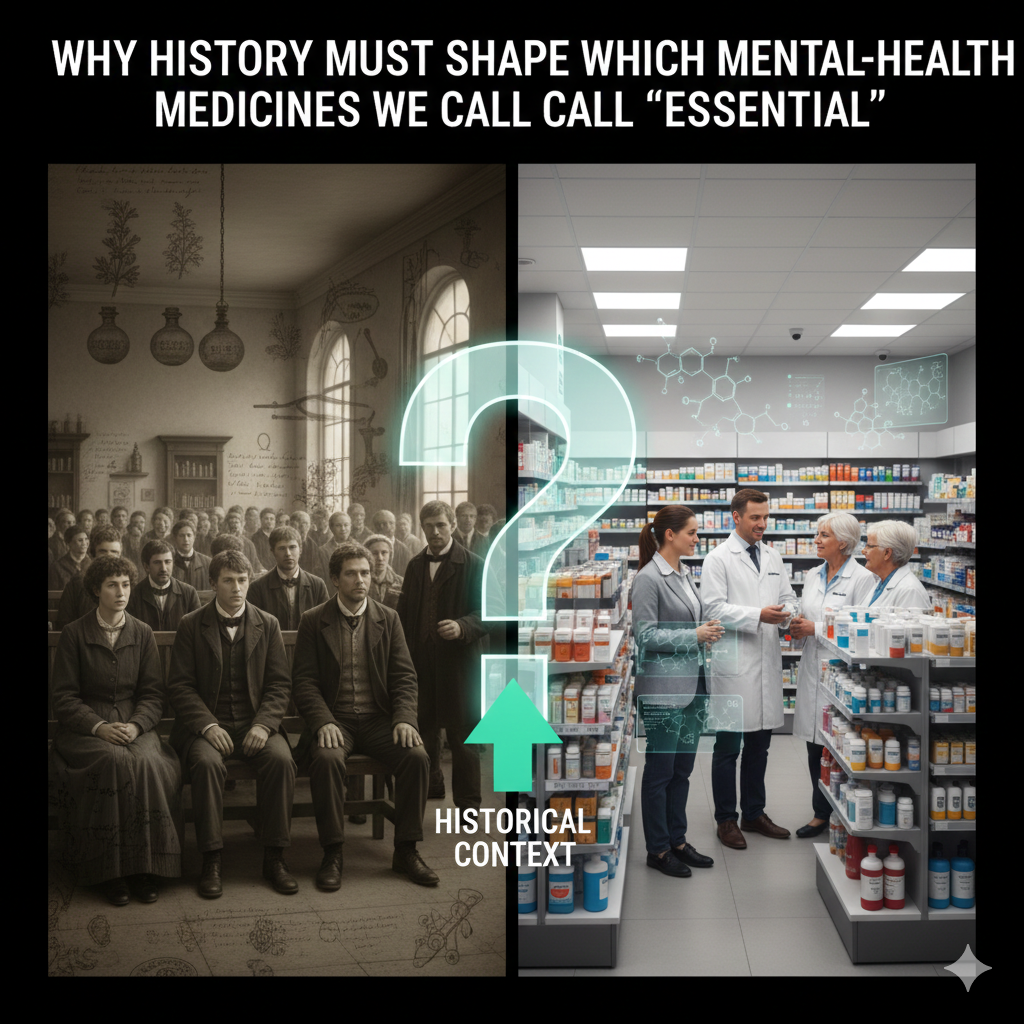
When I stand in a crowded outpatient clinic or pass a fenced psychiatric rehabilitation home, I don’t just see patients with diagnoses. I see a history—a long template of control, silence and quick fixes that keeps replaying itself. That template began with slavery and was reinforced by colonial systems; it migrated into our families, places of worship and health services. Many habits we now call “treatment” still carry traces of that old logic: contain, quiet, obey.
If we’re going to make psychotropic medicines truly “essential,” we must reckon with that history and design systems that heal rather than replicate chains.
The wound: how history shapes care
Slavery and colonialism taught a social order where personal autonomy was diminished and obedience preserved. Over generations, those lessons seeped into parenting, law, education and medicine. When institutions treat people as bodies to be managed rather than humans to be restored, the default responses are control and invisibility.
Human Rights Watch documented that “thousands of people with mental health conditions across Nigeria are chained and locked up in various facilities where they face terrible abuse.” This is a moral emergency as much as a clinical one. True reform must be reparative: it must restore agency and social functioning, not only suppress symptoms.
The gap: millions untreated
In Nigeria, approximately 1 in 5 people—over 40 million—experience mental-health conditions. Yet up to 85% go untreated. That’s systems failure and national loss of human potential.
The NDLEA has established 30 treatment centers nationwide, but services remain fragmented. More than 80% of Nigerians with serious mental illness initially turn to traditional healers or spiritualists before seeking formal care—often because these options are closer, cheaper or more culturally familiar.
Why “essential” matters (and why it’s not enough)
The WHO Model List of Essential Medicines signals which treatments a functioning health system should reliably provide. Including antidepressants, antipsychotics, mood stabilizers and addiction medicines on our essential list would streamline procurement, encourage generics and enable insurance coverage. For millions who cannot afford out-of-pocket care, this could be life-changing.
But medicines don’t operate in a vacuum. In a context still marked by institutionalized control, blunt availability can lead to misuse. Antipsychotics used merely to subdue behaviors can cause sedation, cognitive blunting, movement disorders and metabolic harms—reducing the very participation in therapy, work and family life we want to restore.
The framework: four commitments
Making psychotropics essential demands:
- Embed medicines in comprehensive care – counseling, peer support, family involvement
- Scale community-based models – keep people connected to family and livelihood
- Enforce clinical stewardship – training, monitoring, prescription audits
- Guarantee rights – transparency, oversight, no chaining or abuse
These pillars push the system away from management by restraint and toward recovery by relationship.
Seven actions for policymakers
- Adopt WHO-informed psychotropic lists adapted to local contexts
- Make psychotropics financially accessible through insurance and subsidies
- Train primary-care staff using WHO mhGAP programs with clear referral pathways
- Mandate rational-use measures: documented indications, prescription audits
- Invest in community rehabilitation combining medication with therapy, peer support and job reintegration
- Create a national registry and inspection regime for all mental-health facilities
- Link rehabilitation to broader social supports: housing, education, income
Why this is urgent and possible
We’re not starting from scratch. WHO’s Africa office recently adopted a Regional Strategy for Rehabilitation 2025–2035. The NDLEA’s rollout of 30 centers shows national expansion is feasible.
What we need now: bind these technical efforts to ethical politics. No medicine is truly essential until it’s available in a system that respects autonomy, restores agency and rebuilds community roles.
The choice
I’ve seen too many lives minimized by systems that prefer silence to messy recovery. I’ve seen relatives choke with shame as they lock loved ones away because there was no other care. I’ve seen medicines used to tranquilize rather than restore.
Let us do two things at once:
Make psychotropic medicines available and affordable. Include them on essential-medicines lists. Secure supply chains. Fund them publicly.
Transform the systems that distribute them. Invest in community rehab. Train prescribers in trauma-aware care. Ensure transparency. Build peer networks that return people to dignity and work.
Medicine is essential when it brings people back to life. Medicine is not essential when it only keeps them quiet.
If we’re bold enough to confront the past and careful enough to design for dignity, we can have both access and repair. We can stop handing down chains and start teaching people to walk again.
References
Human Rights Watch (2019). Nigeria: People With Mental Health Conditions Chained, Abused. https://www.hrw.org/news/2019/11/11/nigeria-people-mental-health-conditions-chained-abused
Mental health care services in Nigeria: A qualitative enquiry from family physicians’ perspective. PLOS Mental Health. https://journals.plos.org/mentalhealth/article?id=10.1371/journal.pmen.0000285
NDLEA creates 30 rehabilitation centres to address drug abuse menace. Healthwise. https://healthwise.punchng.com/ndlea-creates-30-rehabilitation-centres-to-address-drug-abuse-menace/
WHO Model List of Essential Medicines – 23rd list, 2023. https://www.who.int/publications/i/item/WHO-MHP-HPS-EML-2023.02
WHO Regional Strategy to Strengthen Rehabilitation in Health Systems 2025–2035. https://www.afro.who.int/sites/default/files/2025-07/AFR-RC75-6%20Regional%20strategy%20to%20strengthen%20rehabilitation%20in%20health%20systems%202025%E2%88%922035.pdf