
Written By: OGWAL EMMANUEL
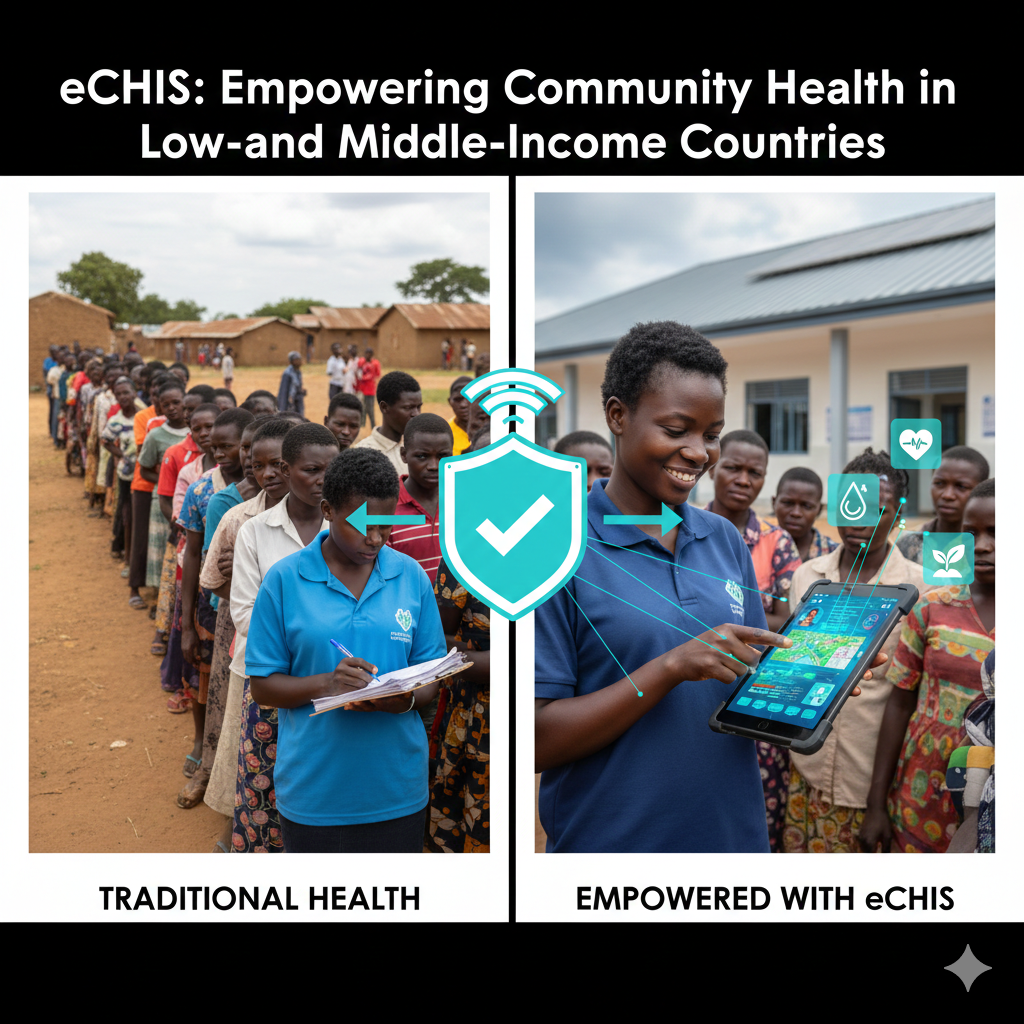
During the recently concluded GDHF, I had the opportunity to learn about eCHIS and how it’s changing health care delivery in LMICs such as Kenya and Uganda. Today, I want to discuss how this is happening.
In today’s fast-evolving world of global health, tools like eCHIS are quietly making a profound impact, especially in regions where resources are limited. As someone who has followed these developments, I’m excited to share what eCHIS is all about—its core features, how it’s reshaping healthcare on the ground, and the promising horizons it opens up.
Defining GDHF and eCHIS
To set the stage, GDHF refers to the Global Digital Health Forum, an annual event that brings together innovators, policymakers, and health experts to explore digital solutions for public health challenges. The 2025 forum, held from December 3-5 in Nairobi, Kenya, emphasized collaborative strategies to advance equitable healthcare worldwide.
eCHIS, or Electronic Community Health Information System, is a digital platform designed to support community health workers (CHWs) in tracking and managing patient data at the grassroots level. Built on open-source technology, such as Medic’s Community Health Toolkit, it runs on mobile devices and integrates with national health systems. In countries like Kenya and Uganda, eCHIS is being implemented on a large scale to digitize health records, enabling offline functionality with later synchronization for areas with unreliable connectivity. Kenya’s eCHIS aligns with its 2020-2025 community health strategy, while Uganda uses it to enhance real-time data collection and decision-making.
How eCHIS Is Revolutionizing Healthcare Delivery
eCHIS addresses longstanding challenges in LMICs by replacing outdated paper-based systems with intuitive digital tools. Community health workers can now input data during household visits, receive automated prompts for follow-ups such as vaccinations or maternal health checks, and alert supervisors to urgent issues in real time..
This shift has led to remarkable improvements. In Kenya, the system has expanded to over 7,500 health facilities, registering millions of individuals and enhancing efforts in areas like malaria surveillance and child nutrition. In Uganda, it accelerates responses to community needs, reduces delays, and improves overall healthcare delivery. By facilitating better data flow, eCHIS helps identify health trends early, supports targeted interventions, and contributes to universal health coverage goals. It’s designed with users in mind, incorporating training to ensure CHWs can adopt it seamlessly, ultimately leading to more accurate records.
The Potentials of eCHIS: Looking Ahead
The true power of eCHIS lies in its scalability and adaptability. As seen in Ethiopia, where it’s reaching thousands of health posts, the system could integrate advanced features like AI-driven analytics to predict health risks or streamline supply distribution.
Future enhancements might include connections to wearable devices for continuous monitoring or telehealth for remote consultations, expanding its reach in underserved areas. It could also enable performance incentives for CHWs, fostering higher-quality care. On a broader scale, eCHIS has the potential to create interconnected health ecosystems, informing national policies and resource allocation for more equitable outcomes.
While obstacles like infrastructure limitations and data security must be navigated through robust governance, eCHIS represents a step toward resilient, inclusive health systems across Africa and similar regions.
In essence, eCHIS isn’t just a tool, it’s a bridge to better health for millions. Insights from events like GDHF remind us that with thoughtful innovation, we can make healthcare work better for everyone.