
Written by: Sarah Abereola
How many digital health innovations have promised to reach women, only to vanish because they assume universal smartphone ownership and stable connectivity? The obsession with high-tech solutions is leaving the very women they intend to help behind.
Based on clinical observations in primary health care centres in Ibadan North, Nigeria, many women and mothers face barriers to accessing digital health services. In one instance, a mother missed multiple immunisation appointments for her child because she received no reminders, having neither a smartphone nor reliable network access. Her child later developed meningitis, a preventable illness. This case illustrates the systemic barriers faced by populations that digital health tools often claim to empower, particularly women, mothers, and caregivers.
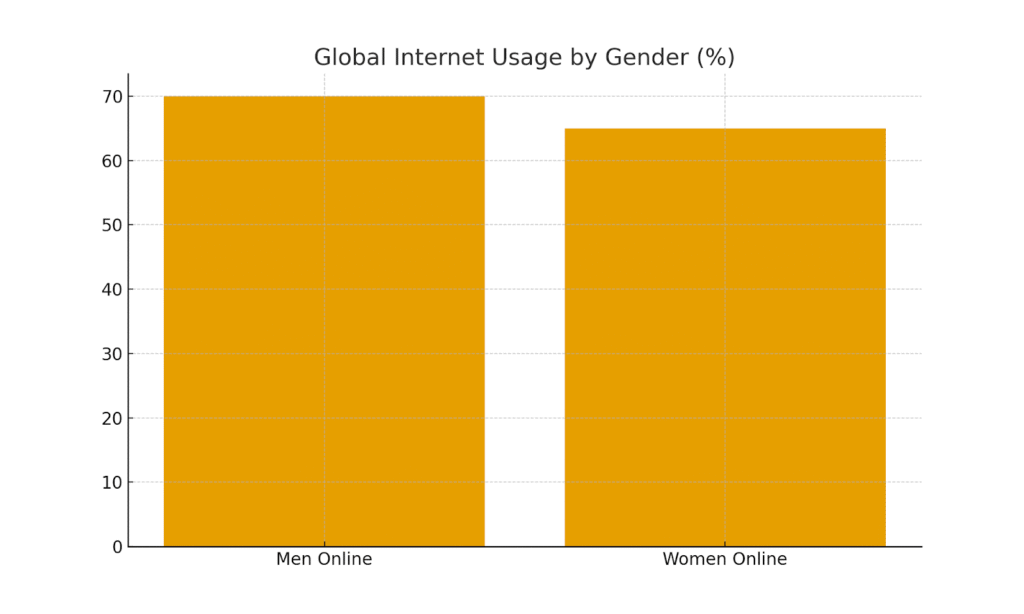
While artificial intelligence (AI) and other digital health innovations promise to transform healthcare delivery, they frequently assume universal access to smartphones, digital literacy, and stable internet connectivity. Globally, approximately 2.6 billion people remain offline, with women disproportionately affected (ITU, 2024; GSMA, 2025). In low- and middle-income countries, an estimated 235 million women are excluded from mobile internet, and in Nigeria, only 39% of women own smartphones (GSMA, 2025). These figures are not merely descriptive; they indicate structural inequities that constrain the reach and effectiveness of digital health interventions.
The real challenge isn’t creating AI that works. It is designing AI that women without smartphones, unstable networks, or digital literacy can actually use right where they are.
That is what programs like MomConnect in South Africa and MOTECH in Ghana have shown. MomConnect now reaches over 5 million women with SMS and voice messages, because the government designed it from day one to be accessible even on basic phones. MOTECH delivers maternal health messages and voice reminders to women in rural Ghana, including those without internet access, embedding AI-assisted guidance into existing workflows.
The Offline Trap Is Real
Every initiative wants to build the perfect app, video, or AI chatbot. Every NGO or startup dream of smartphone-based dashboards. While this sounds reasonable, it leaves billions of women excluded, the same women whose health outcomes programs claim to improve.
Infographic: Global Internet Usage by Gender
How can health systems serve women who are digitally invisible?
The truth is simple: digital innovation is transformative, but only when women can access it.
Five Ways to Make AI Work for Women Offline
1. Design for Accessibility from Day One
Start by understanding what devices women actually have, how they interact with technology, and what infrastructure exists. Examples include:
- USSD-based AI tools: Deliver maternal education, danger-sign screening, reminders, and emergency contacts via simple dial codes like *123# — no smartphone or data needed.
- Offline-first mobile apps: Function fully offline, store content locally, and sync only when a network is available.
- Solar-powered health kiosks: Tablets in PHCs, markets, and community centres with preloaded maternal content, videos, and symptom checkers.
- Voice-based systems (IVR): Reach women who cannot read or write, in local languages such as Yoruba, Hausa, Igbo, Pidgin, and English.
- Offline decision-support tools for health workers: Tablets for nurses and CHWs with digital registers, automated immunisation schedules, and pregnancy risk-score calculators.
- AI-informed paper tools: Pictorial immunisation calendars, danger-sign cards, and flowcharts designed for clarity and behavioural insight.
2. Build Cross-Sectoral Integration
AI works best when aligned with government programs. MomConnect and MOTECH succeeded because they fit into national health systems, not parallel digital experiments.
3. Co-Create With the Full Ecosystem
Frontline health workers, CHWs, nurses, and mothers should be involved from design to deployment. Co-creation ensures solutions are usable, trusted, and practical.
4. Validate Across Contexts
Single-site pilots rarely convince policymakers. Demonstrate that your AI works in urban and rural settings, with women who have and don’t have smartphones, across literacy levels and languages.
5. Plan for Long-Term Sustainability
Programs that succeed integrate into existing workflows and reporting systems. MomConnect’s AI-assisted helpdesk, for example, runs on SMS/IVR and aligns with South Africa’s national health system, ensuring continued use beyond initial funding.
The Path Forward Requires Inclusive Design
The future of AI in health does not belong to the smartest technology, but to the smartest systems thinking. Implementers who design offline-first, women-first solutions — tools that mothers can access without data, apps, or high literacy are the ones who will actually improve maternal and child health outcomes.
We cannot wait for universal smartphone adoption or stable connectivity. If AI is to transform maternal and child health, it must first be accessible to the women who need it the most.
This is the moment to ask clearly;
AI for what?
And more importantly- AI for whom?
References
GSMA. (2025). Progress closing the mobile internet gender gap stalls in LMICs: GSMA Mobile Gender Gap Report 2025. GSMA. https://www.gsma.com/newsroom/press-release/progress-closing-the-mobile-internet-gender-gap-stalls-in-lmics-gsma-mobile-gender-gap-report-2025/
GSMA. (2025). The Mobile Gender Gap Report 2025 [PDF]. GSMA. https://www.gsma.com/r/wp-content/uploads/2025/06/The-Mobile-Gender-Gap-Report-2025.pdf
International Telecommunication Union (ITU). (2024). Global Connectivity Report. ITU. https://www.itu.int/en/ITU-D/Statistics/Pages/publications/default.aspx
MOTECH Evaluation. (2019). Mobile technology for community health in Ghana: Is maternal messaging and provider use of technology cost-effective in improving maternal and child health outcomes at scale? Journal of Medical Internet Research (JMIR), 21(2), e11268. https://www.jmir.org/2019/2/e11268/
South African National Department of Health. (2024, September 18). Health celebrates 10th anniversary of MomConnect to reduce maternal and child mortality rates in SA [Media advisory]. https://www.health.gov.za/wp-content/uploads/2024/09/Health-Department-celebrates-10th-Anniversary-of-MomConnect-to-reduce-maternal-and-child-mortality-rates-in-SA-18-September-2024.pdf
South African National Department of Health. (n.d.). MomConnect – National Department of Health. https://www.health.gov.za/momconnect/
Independent Online (IOL). (2024, September 25). MomConnect celebrates 10 years assisting over 5 million pregnant women. https://www.iol.co.za/technology/gadgets/2024-09-25-momconnect-celebrates-10-years-assisting-over-5-million-pregnant-women/
JMIR mHealth and uHealth. (2018). Forecasting the value for money of mobile maternal health information messages on improving utilization of maternal and child health services in Gauteng, South Africa. https://mhealth.jmir.org/2018/7/e153/