
Written By : Glory Ayobami Ogunbodede
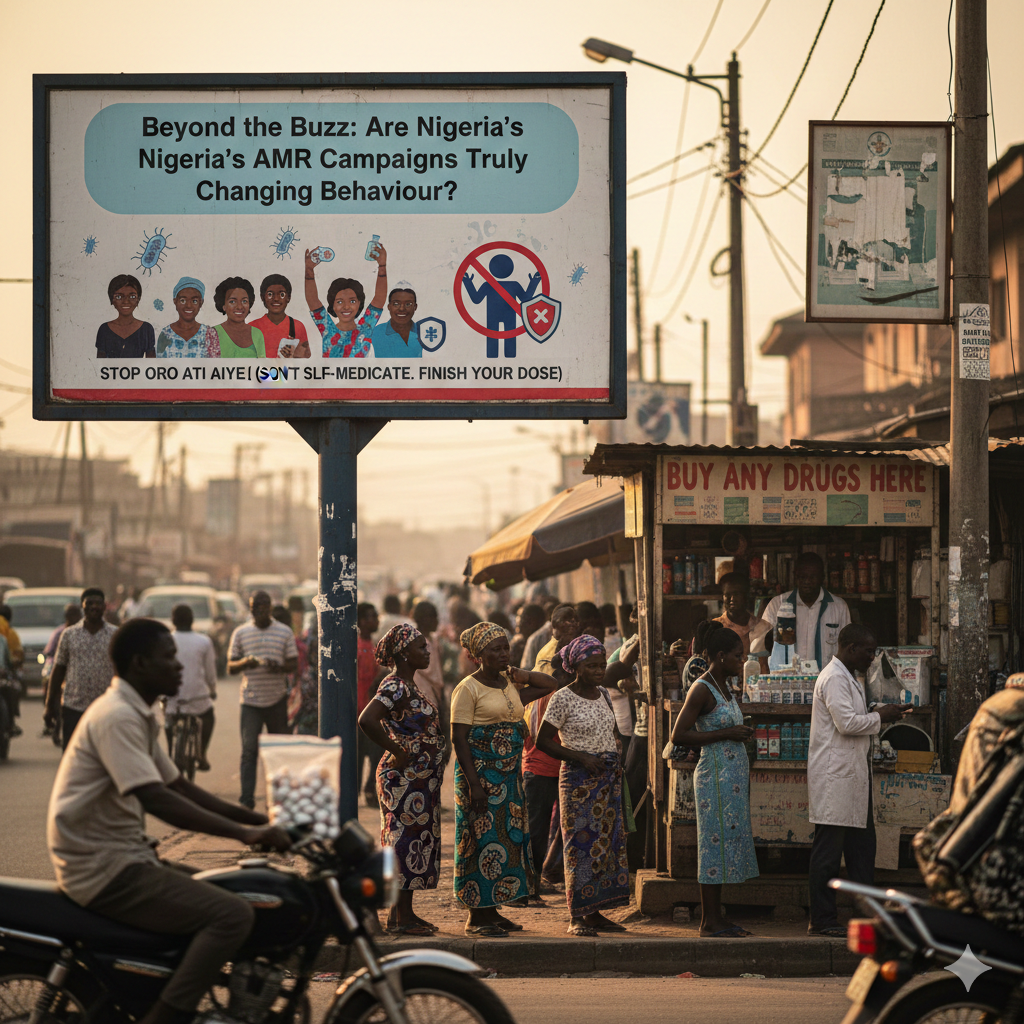
We all know the routine: a child catches a fever, and we skip the doctor, heading straight for the leftover antibiotics in the cupboard. That little pill offers quick relief, but we rarely stop to think: Are we accidentally manufacturing a crisis in that child’s body? That is the quiet tragedy of Antimicrobial Resistance (AMR) in Nigeria. We are fighting a silent pandemic. The mortality burden in Nigeria is of great concern: Nigeria ranks 19th globally in the highest age-standardised mortality rate associated with AMR6. In 2019 alone, there were 64,500 deaths directly attributable to AMR, surpassing the mortality figures associated with diseases like malaria and tuberculosis. The official response to AMR in Nigeria, however, has not been silent, especially in raising awareness. From social media blitzes to awareness walks, the “buzz” around AMR is growing. But as someone deeply concerned about this crisis, I have to ask: are we truly changing behaviours by spreading the word, or are we just hosting events to look busy? I will break it down based on the plans, what has been done, what is left, the hurdles, and where we stand.
First, I will start with the blueprints. The global response, spearheaded by the World Health Organisation (WHO) and its Quadripartite partners, recognises awareness as the cornerstone of any containment strategy. The Global Action Plan (GAP) on AMR adopted in 2015 set “Improve awareness and understanding of antimicrobial resistance through effective communication, education and training” as Objective 1.1 This priority remains central in the subsequent plan, with the draft Second Edition of the GAP (2026–2035) reiterating the need to “Strengthen awareness and promote appropriate social and behaviour change to reduce AMR risks across all sectors”. Nigeria’s National Action Plan (NAP) for AMR reflect this global mandate. The first multisectoral response, detailed in the NAP 1.0 (2017–2022), centred its efforts on Focus Area 1: “Increasing Awareness and Knowledge on AMR and Related Topics.”
Key planned activities included:
- Establishing a Governance Structure: Constituting an evidence-based public communication program under the leadership of a tripartite AMR National Behaviour Change Communication Consultative Group (NBCCCG).
- Evidence Generation: Conducting a nationwide baseline behavioural study on AMR awareness, knowledge, attitudes, practices, and perceptions (KABP).
- Institutionalising Knowledge: Reviewing school curricula (primary, secondary, and tertiary) and professional training guidelines to include AMR, infection prevention and control (IPC), and antimicrobial stewardship (AMS).
The clear intent of this first plan was to establish formal mechanisms for communication and measure existing knowledge gaps against the rising threat.
The recently launched NAP 2.0 (2024–2028) represents a significant evolution in Nigeria’s strategic approach, transitioning from a focus purely on “knowledge” to measurable “behavioural change.” Strategic Objective 2 is clearly articulated as: “Improve antimicrobial resistance (AMR) awareness, education, understanding, and behaviour change among all relevant stakeholders.” This policy adjustment reflects the lessons learned from the failures of NAP 1.0 and aligns directly with the proposed shift in the draft GAP 2.0, which stresses the necessity of moving “beyond awareness-raising to applying behavioural insights that drive sustained changes in individual, collective, and institutional practices”. This move acknowledges that simply informing people about the dangers of AMR (cognitive change) is insufficient; the new plan targets the systemic, structural, and social factors that perpetuate misuse of antibiotics (behavioural change). So, what have we actually done?
A critical review of the NAP 1.0 implementation reveals that while the intention was robust, execution often fell short, particularly concerning the foundational elements necessary for sustained behaviour change. The major impediment was the failure to institutionalise the planned governance structure. The National Behaviour Change Communication Consultative Group (NBCCCG), intended to coordinate and lead communication efforts across sectors, was not successfully established or actively engaged. This operational vacuum meant awareness activities lacked centralised, multisectoral leadership and coordination. Consequently, implementation became episodic rather than continuous. Also, the nationwide baseline KABP survey (Activity 1.1.1.3 in the NAP 1.0 operational plan) was not comprehensively conducted. Without this critical baseline data, subsequent awareness campaigns lacked the evidence needed for targeted messaging and accountability, essentially operating in the dark.
Now, looking critically at the effectiveness of our awareness strategies. Awareness activities in Nigeria have been overwhelmingly clustered around high-visibility moments, primarily the annual World AMR Awareness Week (WAAW). Every year, we see the headlines: pictures of people in branded T-shirts doing AMR walks in Abuja, Lagos and other states. We see the tweets from officials and the media blitzes, all part of the necessary global performance. Nigeria has ticked the high-level policy boxes, establishing the AMR Technical Working Group and improving its scores on the global tracking tool (TrACSS) for public health awareness. These efforts create an essential impression of progress. Yet, this flurry of activity often feels performative; a one-week blitz versus sustained education. What good is the buzz when the information never makes it past the social media feed, and a mother is still selling antibiotics over the counter in her local clinic? The effort is visible, but the impact feels agonisingly brief.
The contrast between the institutional “buzz” and the human reality is stark. The people most at risk, our neighbours, our parents, and we, are still dangerously unaware.
The Mother and the Chemist: A 2025 study on prioritising AMR interventions in Nigeria found low public awareness, with misuse rampant because it’s easier and cheaper to self-medicate or buy drugs over the counter than see a doctor. We know antibiotics aren’t candy, but the economic pressure and the convenience of quick fixes mean old habits die hard without enforcement like banning over-the-counter (OTC) sales.
The Farmer’s Loss: Think about the farmer who just invested everything in his livestock. When an animal gets sick, he doesn’t consult the NAP report; he reaches for the quickest, cheapest drug to save his livelihood. The AMR messages that reach our city doctors are not reaching him, and he is creating resistance that eventually finds its way back to our plates. TrACSS 2022-2025 data echoes this: while education and training have advanced (e.g., in human health), public campaigns need more targeting, and sectors like the environment lag.
The Rural Divide: NAP 2.0’s SWOT analysis admits weaknesses like minimal coverage in private facilities and low grassroots awareness, despite strengths like yearly WAAW leadership. This crisis is amplified by a severe urban bias. While city centres host the awareness walks, rural Nigeria is left behind, where awareness is lowest, and impacts are highest. The current approach is failing to penetrate the community level, where behaviour change truly starts.
What’s left to do? Plenty. The time for performative conferences has passed. This is no longer a policy problem; it’s a moral and execution problem. We need to demand that our leaders stop funding the buzz and start funding the programs that directly protect our families. This requires:
Enforcement and Integration: Mandating AMR curricula for all professionals (vets, doctors, farmers) and enforcing rules against OTC sales.
Sustained Coordination: Breaking down the weak silos between Health, Agriculture, and Environment ministries to ensure a uniform message.
Grassroots Investment: Funding decentralised, year-round campaigns that use local faith-based and village meetings to reach every Nigerian.
How close are we to achieving this? I’d say midway-maybe 40-50% based on TrACSS benchmarks and self-reports. We’ve built frameworks and run campaigns aligning with GAP and NAP goals, but true success means measurable shifts: lower resistance rates, reduced misuse, and surveys showing high awareness (currently, public levels hover below 50% in studies). With NAP 2.0’s focus on evidence-based tweaks and community-driven approaches, we could get closer by 2028, but it needs political will and funding. Ultimately, if we’re just drawing attention without changing lives, we’re not there yet. We must make the fight personal, sustained, and accountable. Our collective health depends on pushing for a shift from high-level noise to measurable results. So, let’s push for more; our health depends on it.