
Written By: Aminu Muhammad
Introduction
A digital twin is a virtual representation of a physical object or process capable of collecting information from the real environment to represent, validate and simulate the physical twin’s present and future behavior. As digital health continues to evolve, digital twin technology has emerged as one of its most ambitious promises. By creating virtual representations of patients that continuously integrate clinical, behavioral, and environmental data, digital twins aim to predict disease trajectories, simulate interventions, and support proactive care. In theory, this marks a shift from reactive medicine to predictive, personalized healthcare.
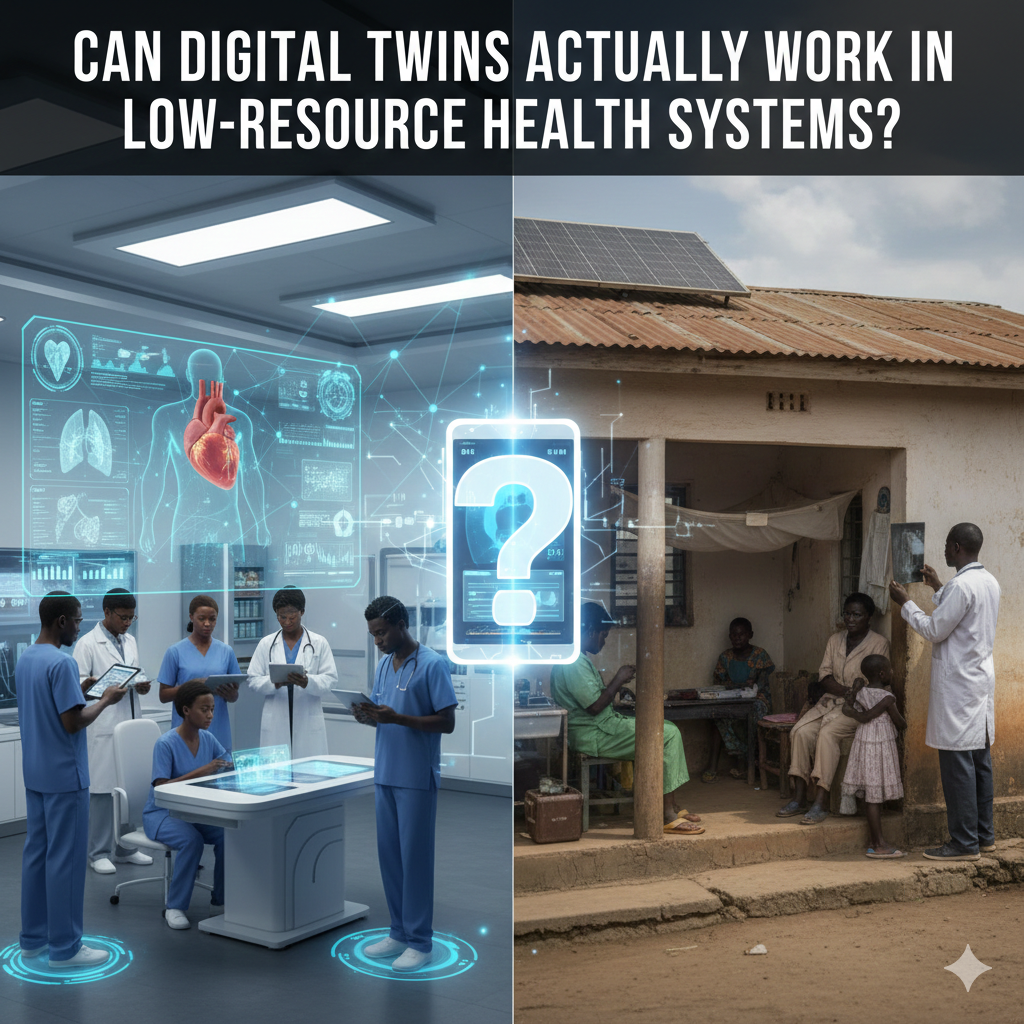
Yet as someone working at the intersection of digital health, monitoring, and global health equity, I find that the conversation around digital twins often skips a critical step: context. Innovation alone does not guarantee impact. In low-resource health systems, where data infrastructure remains fragmented and access to care uneven, the real question is not whether digital twins are possible—but whether they are accessible, appropriate, and equitable.
The World Health Organization’s Global Strategy on Digital Health 2020–2025 emphasizes that digital transformation must strengthen health systems and expand access, not amplify disparities (WHO, 2020). This principle resonates strongly across many African contexts, where the burden of disease continues to rise faster than the systems designed to manage it. Digital twins, if deployed without deliberate adaptation, risk becoming another advanced solution built on foundations that are not yet ready.
What Digital Twins Promise in Healthcare.
At their core, digital twins offer a compelling value proposition. They enable clinicians to anticipate risk rather than respond to crises, particularly in chronic disease management. By modeling physiological changes over time, digital twins can support early intervention, optimize treatment pathways, and reduce long-term complications.
Global examples demonstrate this potential. Dassault Systèmes’ Living Heart Project explores how virtual cardiac models can simulate disease progression and treatment effects. Similarly, research initiatives within the UK’s National Health Service have examined digital twins for population health planning and system optimization. These efforts show what is technically feasible when data systems, governance, and clinical integration align.
However, feasibility in high-income settings does not automatically translate to viability elsewhere.
Why Low-Resource Health Systems Change the Equation
Low-resource health systems operate under different constraints. Many facilities still rely on paper-based records. Diagnostic data may be intermittent or unavailable. Internet connectivity and power supply remain inconsistent in rural areas. These realities directly challenge the assumptions digital twins rely on—continuous data flow, interoperability, and longitudinal patient records.
The African Union Digital Transformation Strategy for Africa (2020–2030) explicitly warns against adopting advanced digital solutions without parallel investment in foundational systems. When health data remains siloed or incomplete, digital twins risk producing insights for a small, digitally visible population while excluding those already underserved.
The Real Barriers
Beyond technology, the primary barriers to digital twinning in low-resource settings are structural, not technical.
First, data availability and bias limit model reliability. Algorithms trained on non-representative datasets may misclassify risk or reinforce inequities.
Second, interoperability gaps prevent meaningful integration across laboratories, clinics, and monitoring tools.
Third, trust and governance concerns—including data ownership, consent, and explainability—shape adoption as much as performance.
Finally, human capacity remains a bottleneck; without trained health workers and data stewards, even the best models fail at the point of care.
What Digital Twinning Can Realistically Look Like
A more practical pathway begins with incremental digital twinning. Rather than full physiological replicas, low-resource systems can deploy monitoring-focused predictive models that simulate risk trajectories using limited but high-value data.
For example, models that track blood pressure trends, glucose readings, or inflammatory markers over time can function as early-stage digital twins—supporting risk stratification, follow-up prioritization, and clinical decision support.
As data systems mature, these models can evolve in complexity. This approach aligns innovation with readiness and prioritizes reach over sophistication.
Lessons From Early AI Deployments
African AI deployments reinforce this lesson. Babylon Health’s Rwanda initiative scaled access to digital consultations but required deep government partnership and years of localization.
EyeArt’s diabetic retinopathy screening shows clinical value but depends on specialized equipment and stable connectivity.
These examples highlight a consistent truth: technology succeeds only when systems are ready to sustain it.
Conclusion and Recommendations
Digital twins hold real promise—but promise without context risks exclusion. In low-resource health systems, success depends less on advanced modeling and more on foundational readiness, governance, and equity-driven design.
Policymakers should prioritize interoperability standards, health information exchange, and data governance frameworks. Innovators should build monitoring-first, explainable, and offline-capable models that grow alongside health systems. Global health actors must shift investment from isolated pilots to digital public goods that strengthen system foundations.
As an HSB Global Health Fellow, I see digital twins not as distant futuristic artifacts, but as evolving tools—ones that must meet people where they are before modeling where they could be. Beyond the buzz, the future of digital twinning in global health will be defined not by how advanced our models become, but by who they ultimately serve