
Written by: Musbau Mubarak Remilekun
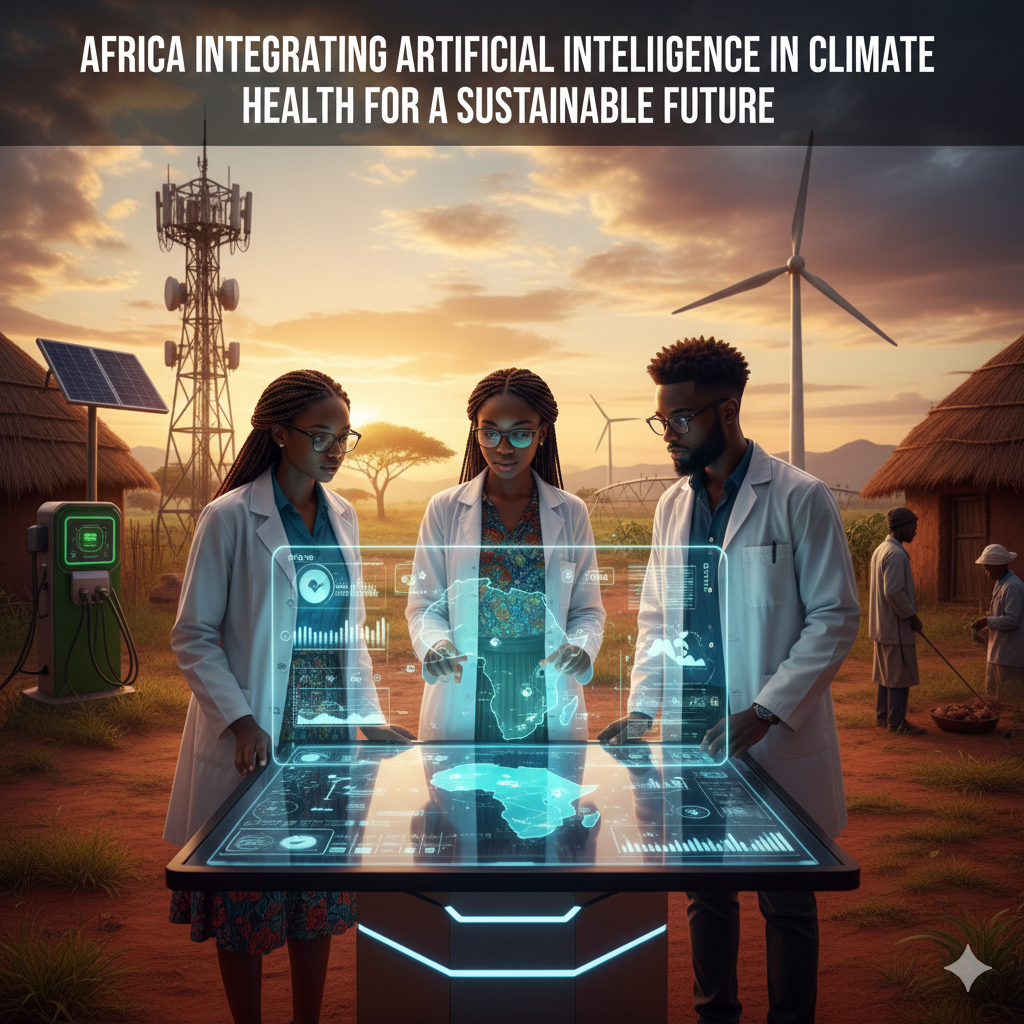
Climate change is a global crisis resulting from human activities that poses a significant challenge to global health. The effects of climate change on human health are considerable, ranging from respiratory and cardiovascular diseases to other serious conditions. Numerous organizations have emphasized the urgent need to address and mitigate these impacts.
Artificial intelligence (AI) involves the simulation of human cognitive processes, such as critical thinking, decision-making, and pattern recognition. AI plays a crucial role in tackling climate change. The emergence of AI and deep learning technologies has marked a transformative period in various sectors, especially in sustainability. AI is a powerful approach to mitigate the health impacts of the climate crisis. However, the application and attention it receives are less focused in Africa, despite the fast-growing tech innovation globally. Therefore, this article will highlight how AI can be integrated into climate health, with a specific focus on addressing the challenges and gaps in Africa.
Integrating AI into climate health is vital for addressing health risks linked to climate change. AI models can enable disease surveillance and prediction, allowing for adequate measures to mitigate and prevent outbreaks. For instance, AI-powered smart sensors can collect, process, and analyze weather and climate pattern data to predict disease outbreaks, such as malaria and cholera. These predictions facilitate proactive measures and public sensitization.
The healthcare sector itself is responsible for approximately 5% of greenhouse gas emissions, with departments like radiology consuming high amounts of energy. The greenhouse effect is a global challenge that increases the intensity and frequency of natural disasters such as floods, droughts, and hurricanes. These disasters ultimately lead to higher rates of communicable and non-communicable diseases and facilitate their transmission. Using AI in healthcare is not only important for optimizing workflows but also for reducing the energy consumption and carbon emissions associated with medical equipment. In many African countries, frequent power failures necessitate the use of diesel generators, which emit significant smoke and greenhouse gases. So, actively exploring techniques like model compression, quantization, and pruning to create more compact and computationally efficient AI models without compromising performance can actually reduce energy consumption and greenhouse gases.
Furthermore, AI plays a pivotal role in enhancing environmental monitoring by collecting and analyzing data from various sensors and remote sensing technologies. Having a device that can monitor the environment and forecast incidents of flooding or drought is critical, as floods can increase the transmission of waterborne and airborne diseases and destroy healthcare infrastructure. For instance, the flooding that occurred in Maiduguri in 2025. Maiduguri is a Borno State’s capital, sits on a flat, semi-arid plain in Northeast Nigeria, characterized by seasonal River Ngadda, hot temperatures, and vulnerable to desertification, with its geography shaped by proximity to Lake Chad, featuring aeolian soils, and facing water scarcity exacerbated by climate change and population growth. The incidence of flood was a major disaster that destroyed lives and property. A multibillion-dollar cancer treatment device, such as a linear accelerator serving the entire northeast population, was destroyed. This left patients undergoing cancer treatment hopeless, potentially leading to cancer recurrence or complications due to interrupted treatment. Therefore, integrating AI models to process climate and weather data to predict natural disasters is paramount in climate health to prepare the populace for their effects.
The traditional method of receiving healthcare services for non-emergency cases often requires patients to travel, resulting in carbon emissions that contribute to the greenhouse effect and ultimately affect global health. AI-enhanced telemedicine can facilitate remote consultations, reducing the need for patient travel and its associated carbon emissions.
In conclusion, the integration of Artificial Intelligence presents a powerful and multifaceted approach to mitigating the health impacts of the climate crisis. By enabling precise disease forecasting, enhancing environmental monitoring for early disaster warnings, optimizing healthcare’s own carbon footprint, and facilitating low-carbon telemedicine, AI emerges as an indispensable tool. Harnessing these AI capabilities is not merely a technological advancement but a critical imperative for building resilient health systems and steering us toward a more sustainable and healthier future for all. This requires targeted investment in infrastructure that can withstand climate disasters, bridge the digital divide, and prioritize energy-efficient AI deployment to effectively address the unique climate health vulnerabilities across Africa.
References
Ueda, D., Walston, S.L., Fujita, S., Fushimi, Y., Tsuboyama, T., Kamagata, K., Yamada, A., Yanagawa, M., Ito, R., Fujima, N. and Kawamura, M., 2024. Climate change and artificial intelligence in healthcare: Review and recommendations towards a sustainable future. Diagnostic and interventional imaging, 105 (11), pp.453-459.
Srivastava, A., Maity, R., Srivastava, A. and Maity, R., 2023. Assessing the potential of AI–ML in urban climate change adaptation and sustainable development. Sustainability, 15 (23), 16461 [online]
Or, Z. and Seppänen, A.V., 2024. The role of the health sector in tackling climate change: A narrative review. Health Policy, 143, p.105053.
Gryshova, I., Balian, A., Antonik, I., Miniailo, V., Nehodenko, V. and Nyzhnychenko, Y., 2024. Artificial intelligence in climate smart agriculture: Toward a sustainable farming future. Access-BG Journal, 5 (1) [online]
Fan, Z., Yan, Z. and Wen, S., 2023. Deep learning and artificial intelligence in sustainability: a review of SDGs, renewable energy, and environmental health. Sustainability, 15(18), p.13493.
Al-Raeei, M., 2024. Artificial intelligence for climate resilience: advancing sustainable goals in SDGs 11 and 13 and its relationship to pandemics. Discover Sustainability, 5(1), p.513.